Heathrow scraps 100ml liquid container limitBritish Broadcasting CorporationBritish Broadcasting Corporation
Heathrow scraps 100ml liquid container limit

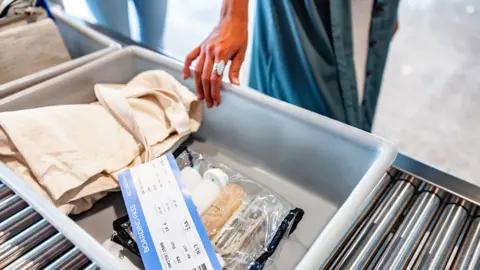
Passengers at Britain's biggest airport, Heathrow, can leave liquids in containers up to two litres in their bags while going through security, after it finally completed the rollout of new high-tech CT scanners.
Electronics such as laptops can also be left in luggage, while clear plastic bags for liquids no longer have to be used.
Heathrow now says it is the biggest airport in the world to have the new equipment fully rolled out across all its terminals.
But while it has become the largest airport to roll out the new high-tech scanners, it is far from the UK's first, with Gatwick, Edinburgh and Birmingham airports having upgraded to them in recent years and increased to a two-litre limit.
At most UK airports, passengers can keep liquid containers of up to 100ml in their luggage, without having to remove them and use clear plastic bags.
Bristol and Belfast airports have also raised their liquid limits to two litres.
However, other airports that have the new scanners installed are waiting for the green light from the Department for Transport (DfT) to raise the limit from 100ml.
A recent report by consumer group Which? found that the sensitivity of the new scanners being rolled out means that at some airports, more bag searches end up being carried out by hand after passing through them.
Heathrow said the scanners, which provide better images of cabin bags, could service "thousands of passengers an hour with significantly greater efficiency, while maintaining high safety and security standards".
The rule change only applies to flights leaving Heathrow, and passengers must check restrictions on luggage at the airports they are returning from before boarding flights to the UK.
The rollout of the new high-tech scanners across the UK has suffered a series of setbacks over the past few years.
Boris Johnson promised in 2019 that the rules about taking liquids through security in containers of no more than 100ml, inside plastics bags, would be scrapped by the end of 2022. The pandemic eventually put paid to that.
In December 2022, the Conservative government promised state-of-the-art scanning equipment would be installed in security lanes by June 2024 in the "biggest shake-up of airport security rules in decades".
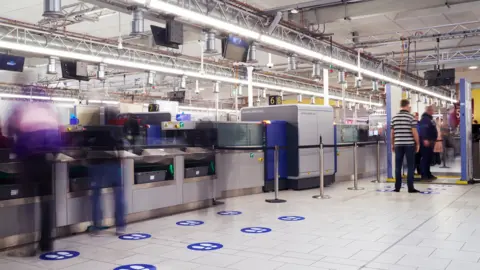
Then-Transport Secretary Mark Harper said the dominance of "tiny toiletry" was nearly over.
But, as it turned out, the June 2024 deadline was not achievable for the biggest airports - although a number of smaller ones, with fewer lanes to get sorted, did install the scanners in place before that date.
Then, on the evening of Friday 13 June, 2024, the government said those smaller airports who had already introduced the new scanners and dropped their 100ml liquids rules, must reinstate them. This triggered anger among airport operators.
The EU also announced a reversion to the 100ml rule in July that year.
There has since been a period of inconsistency. Last summer, the Transport Secretary was telling passengers to assume the 100ml rule still applied.
Heathrow chief executive Thomas Woldbye said the £1bn package of upgrades would mean passengers could spend "less time preparing for security and more time enjoying their journey".
Of the world's busiest 10 airports, Heathrow is the only one to have scrapped the 100ml rule for liquid containers on international flights.
A DfT spokesperson said: "Heathrow is the latest UK airport to complete its rollout of next-generation security equipment for passengers, helping ensure security checks remain robust and can be completed smoothly.
"Airports are responsible for the installation and operation of security equipment.
"Passengers should continue to check security requirements with airports before they travel and come prepared with liquids in containers no larger than 100ml in hand baggage unless advised otherwise."
The Advantage Travel Partnership, a network of travel agents, said airports setting their own timelines on the lifting of the 100ml cap has "led to confusion and frustration" and passengers have been "tripped up".
Chief executive Julia Lo Bue-Said said: "We would urge UK airports to work collectively with the government to ensure there is clear messaging around the rules to avoid confusion and delays where possible."
Meeting is 'reset moment' for tourism sector
New start touted for tourism after board collapse
Ryanair fares to rise as passenger numbers forecast to surge
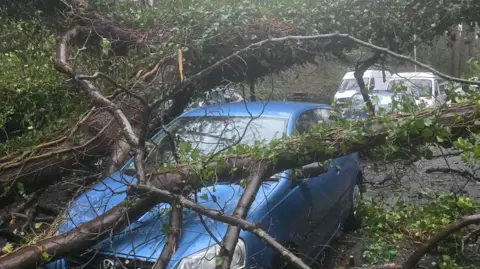
Severe gales cause widespread travel disruption
Severe gales brought by Storm Chandra cause flight and ferry cancellations and road closures.
Airlines pay out millions after initially rejecting claims
Passengers accuse carriers of "confusing" them into dropping compensation claims for cancelled flights.
The islands where emergency care requires a plane
Thousands of islanders travel for vital treatment in NHS hospitals on the UK mainland every year.
'Concorde could fly you on day-trip to Niagara Falls'
Concorde's maiden flight was in January 1976, and one is now a visitor attraction at Manchester Airport.
Airport to examine electric 'sky taxi' potential
Doncaster Sheffield Airport says it wants to do something "different and unique" when it reopens.
The BBC is in multiple languages
Copyright 2026 BBC. All rights reserved. The BBC is not responsible for the content of external sites. Read about our approach to external linking.