Everything Will Be Represented in a Virtual Twin, Jensen Huang Says at 3DEXPERIENCE World | NVIDIA Blog
Artificial Intelligence Computing Leadership from NVIDIA

Everything Will Be Represented in a Virtual Twin, Jensen Huang Says at 3DEXPERIENCE World
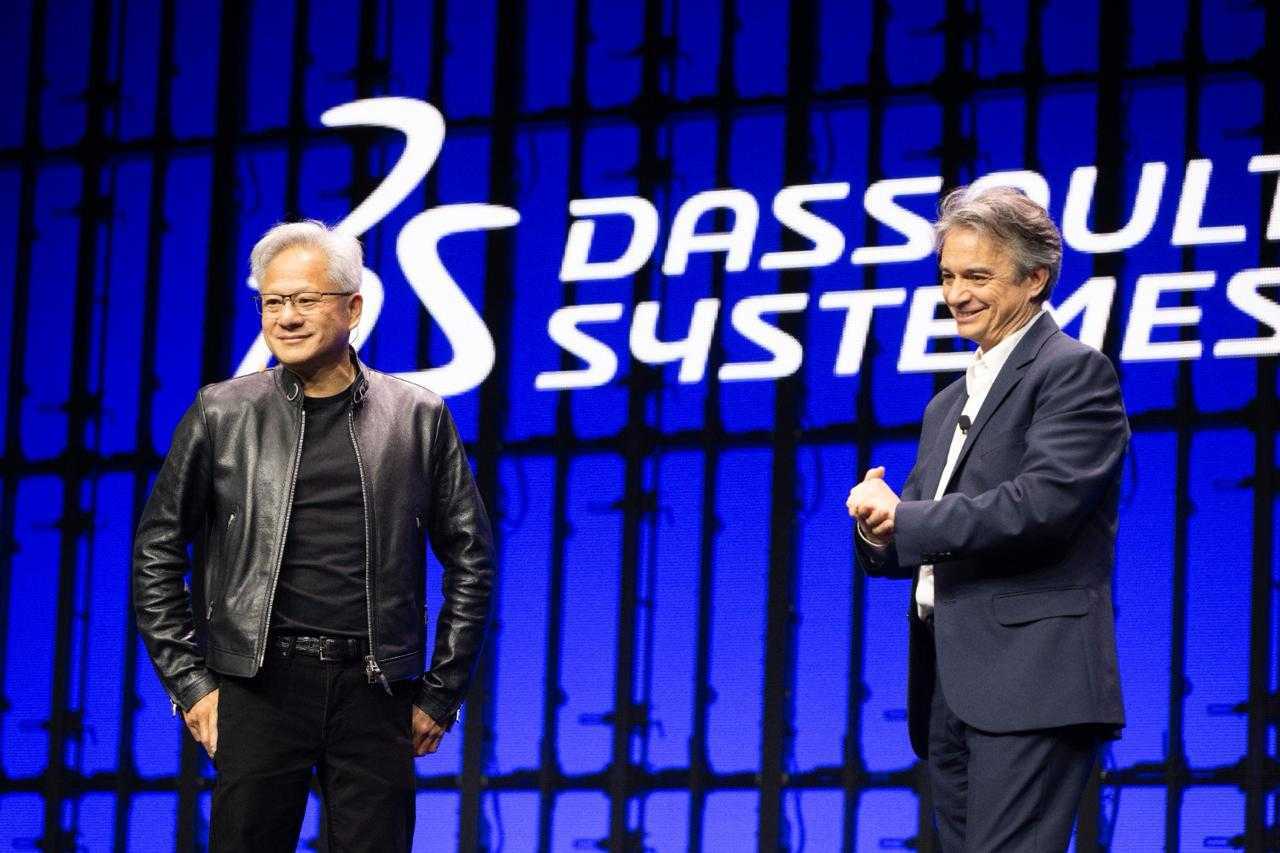
At 3DEXPERIENCE World in Houston, NVIDIA founder and CEO Jensen Huang and Dassault Systèmes CEO Pascal Daloz laid out a blueprint for industrial AI rooted in physics-based “world models” — systems designed to simulate products, factories and even biological systems before they’re built.
“Artificial intelligence will be infrastructure,” like water, electricity, and the internet Huang told the crowd, playfully referring to the engineering-heavy audience as “Solid Workers,” a nod to Dassault Systèmes’ SolidWorks platform.
The announcement continues a collaboration spanning more than a quarter century between NVIDIA and Dassault Systèmes.
“This is the largest collaboration our two companies have ever had in over a quarter century,” Huang said. “We’re going to fuse these technologies so engineers can work at a scale that’s 100 times, 1,000 times — and eventually a million times greater than before.”
The new partnership brings NVIDIA accelerated computing and AI libraries together with Dassault Systèmes’ Virtual Twin platforms to move more engineering work into real-time digital workflows, powered by AI companions that help teams explore, validate, prototype and iterate faster.
Huang framed the shift as a reinvention of the computing stack: moving from hand-specified, structured digital designs to systems that can generate, simulate and optimize in software — at industrial scale.
From Digital Models to Industry World Models
Virtual twins are not applications, “they are knowledge factories,” Daloz said.
The partnership aims to establish industry world models — science-validated AI systems grounded in physics that can serve as mission-critical platforms across biology, materials science, engineering and manufacturing.
In Daloz’s framing, the value moves upstream: virtual twins become the place where knowledge is created, tested, and trusted — before anything is built in the physical world.
Dassault Systèmes, whose 3DEXPERIENCE platform serves more than 45 million users and 400,000 customers globally, has long been a leader in virtual twin technology — digital replicas that let engineers simulate products and processes before building them physically.
The collaboration brings together accelerated computing, AI and digital twin technologies so engineers can design not only geometry, but behavior — and explore radically larger design spaces earlier in development.
Together, the companies outlined how this shared architecture will show up across science, engineering and manufacturing workflows:
Huang said that in domains like biology and materials, the frontier is learning the underlying “language” of complex systems and then generating new options that can be evaluated and validated in simulation.
Designing and Operating the Factory in Software
A central theme of the discussion was how factories themselves are changing — from static physical assets to living systems that are designed, simulated and operated as virtual twins.
As part of the partnership, Dassault Systèmes is deploying NVIDIA-powered AI factories on three continents through its OUTSCALE sovereign cloud, enabling customers to run AI workloads while maintaining data residency and security requirements.
Both executives emphasized that the goal isn’t to replace engineers — it’s to amplify them. As AI agent companions take on more exploratory and repetitive tasks, designers and engineers gain leverage and creativity, not redundancy.
AI Companions That Expand Human Creativity
Every designer will have a “team of companions,” Huang said — a shift he described as fundamentally positive for engineers, software platforms and the broader ecosystem built on them.
For the tens of millions of engineers who use Dassault Systèmes tools to design everything from aircraft to consumer packaged goods, the shift isn’t about replacing human creativity — it’s about expanding it.
“Success is not about automation,” Daloz said. “[Engineers] don’t want to automate the past — they want to invent the future.”
Looking ahead, Daloz framed the partnership as about more than performance gains – it’s an effort to open new possibilities, help companies eliminate bad choices before they become expensive mistakes, and create entirely new categories of products.
“Virtual twins and the 3D Universes are not applications,” Daloz said. “They are knowledge factories.”
The fireside conversation between Huang and Daloz was broadcast live from 3DEXPERIENCE World.

All NVIDIA News
Mercedes-Benz Unveils New S-Class Built on NVIDIA DRIVE AV, Which Enables an L4-Ready Architecture
Into the Omniverse: Physical AI Open Models and Frameworks Advance Robots and Autonomous Systems
GeForce NOW Brings GeForce RTX Gaming to Linux PCs
Defining Her Own Path: Asma Farjallah’s Pursuit of Excellence in AI
NVIDIA Launches Earth-2 Family of Open Models — the World’s First Fully Open, Accelerated Set of Models and Tools for AI Weather
Corporate Information
Get Involved
News & Events
Share on Mastodon
Friend's Email Address
Your Name
Your Email Address
Comments
Send Email