UniRG: Scaling medical imaging report generation with multimodal reinforcement learning - Microsoft ResearchYour Privacy Choices Opt-Out Icon

Global
Microsoft Research Blog
UniRG: Scaling medical imaging report generation with multimodal reinforcement learning
Published
January 27, 2026
By
Sheng Zhang , Principal Researcher Flora Liu , Senior Researcher Guanghui Qin , Senior Researcher Mu Wei , Principal Applied Science Manager Hoifung Poon , General Manager, Real-World Evidence
Share this page

At a glance
AI can be used to produce clinically meaningful radiology reports using medical images like chest x-rays. Medical image report generation can reduce reporting burden while improving workflow efficiency for healthcare professionals. Beyond the real-world benefits, report generation has also become a critical benchmark for evaluating multimodal reasoning in healthcare AI.
Despite recent advances driven by large vision–language models, current systems still face major limitations in real-world clinical settings. One challenge stems from the wide variation in radiology reporting practices across institutions, departments, and patient populations. A model trained with supervised fine-tuning on one set of data may learn its specific phrasing and conventions instead of more general patterns—a problem known as overfitting. As a result, the model performs well on that data but delivers poor results when evaluated on unseen institutions or external datasets. Moreover, since model training is often aimed at producing text that looks similar to existing reports, some well written but clinically inaccurate reports can slip through.
In this blog, we introduce Universal Report Generation (UniRG) (opens in new tab), a reinforcement learning–based framework for medical imaging report generation. This work is a research prototype intended to advance medical AI research and is not validated for clinical use. UniRG uses reinforcement learning as a unifying mechanism to directly optimize clinically grounded evaluation signals, aligning model training with real-world radiology practice rather than proxy text-generation objectives. Using this framework, we train UniRG-CXR (opens in new tab), a state-of-the-art chest x-ray report generation model at scale, spanning over 560,000 studies, 780,000 images, and 226,000 patients from more than 80 medical institutions.
To our knowledge, this is the first report generation model to achieve consistent state-of-the-art performance across report-level metrics, disease-level diagnostic accuracy, cross-institution generalization, longitudinal report generation, and demographic subgroups. These results demonstrate that reinforcement learning, when guided by clinically meaningful reward signals, can substantially improve both the reliability and generality of medical vision–language models.

Azure AI Foundry Labs
Get a glimpse of potential future directions for AI, with these experimental technologies from Microsoft Research.
A unified framework for scaling medical image report generation
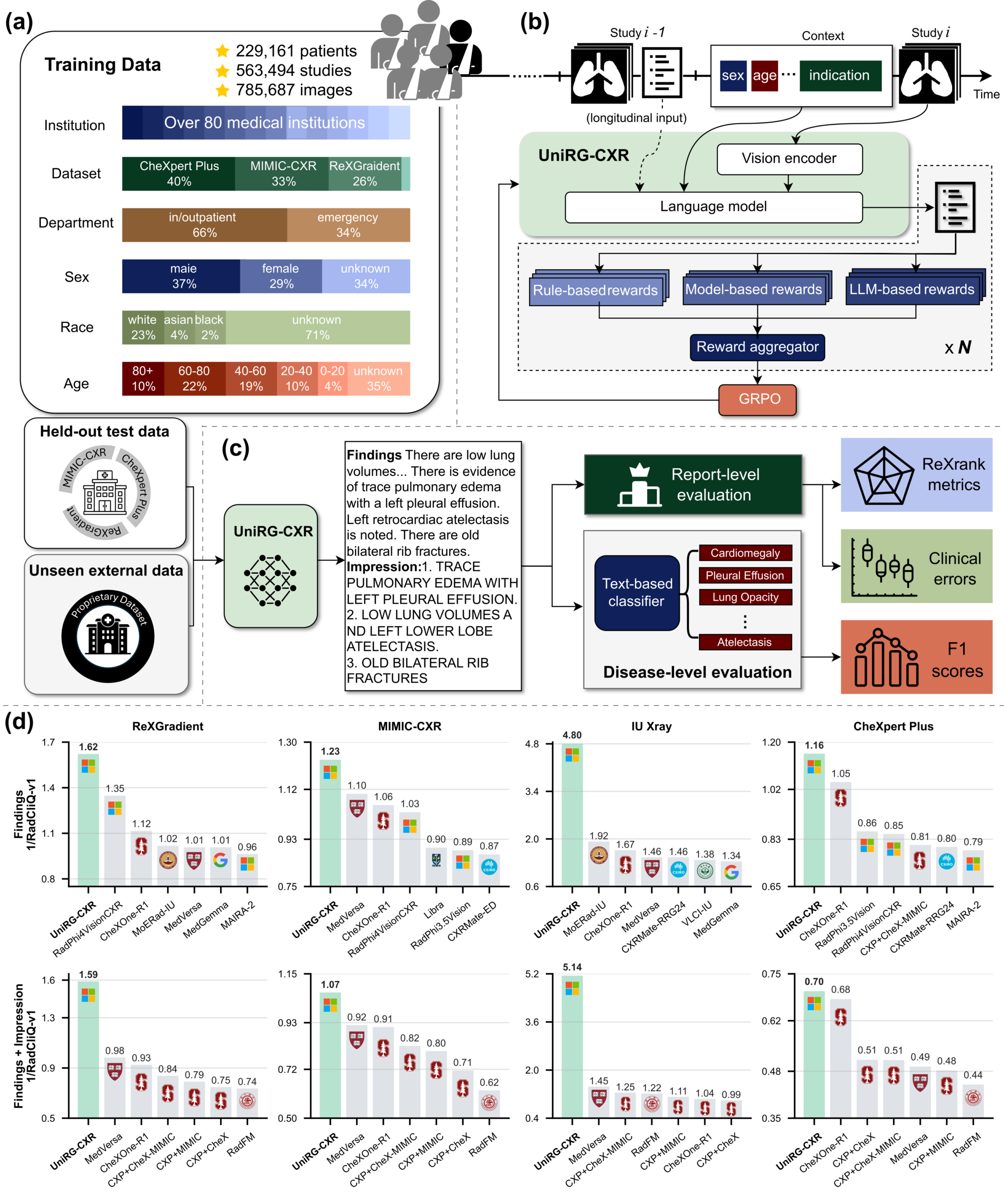
UniRG builds state-of-the-art report generation models by combining supervised fine-tuning with reinforcement learning, which optimizes a composite reward that integrates rule-based metrics, model-based semantic metrics, and LLM-based clinical error signals. This approach allows the resulting model UniRG-CXR to learn from diverse data sources, move beyond dataset-specific reporting patterns, and learn representations that generalize across institutions, metrics, and clinical contexts. Notably, UniRG-CXR sets a new state of the art on the authoritative ReXrank leaderboard (opens in new tab), a public leaderboard for chest X-ray image interpretation, as of 01/22/2026, surpassing previous best models by substantial margins (Figure 1).
Universal improvements across metrics and clinical errors
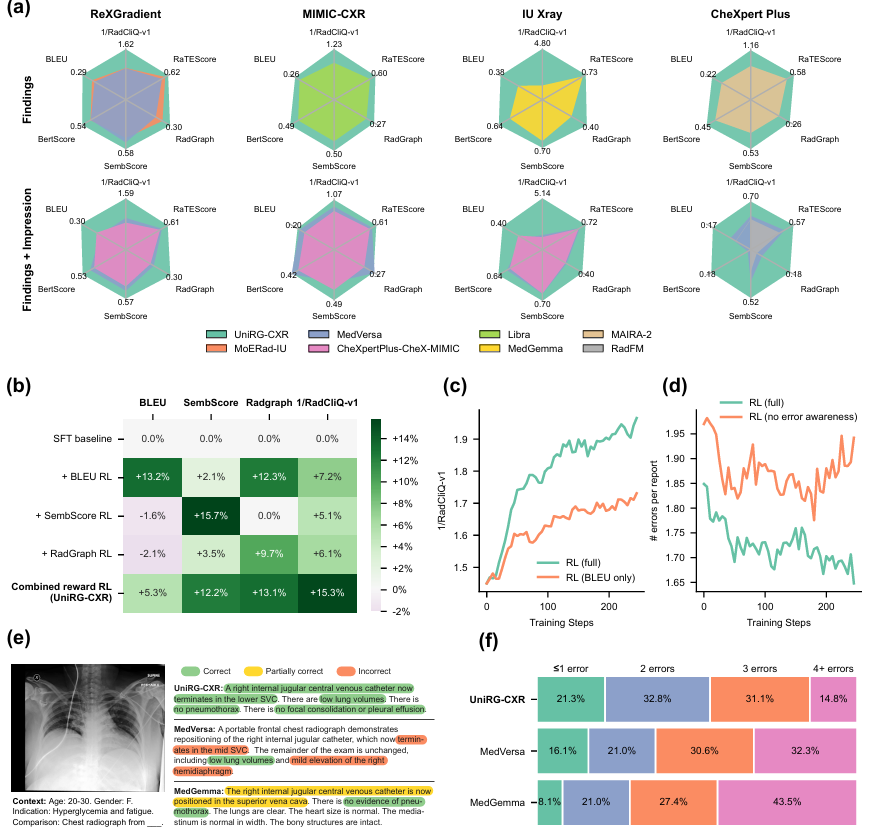
Rather than excelling on one metric at the expense of others, UniRG-CXR delivers balanced improvements across many different measures of report quality. More importantly, it produces reports with substantially fewer clinically significant errors. This indicates that the model is not just learning how to sound like a radiology report, but is better capturing the underlying clinical facts. Explicitly optimizing for clinical correctness helps the model avoid common failure modes where fluent language masks incorrect or missing findings (Figure 2).
Strong performance in longitudinal report generation
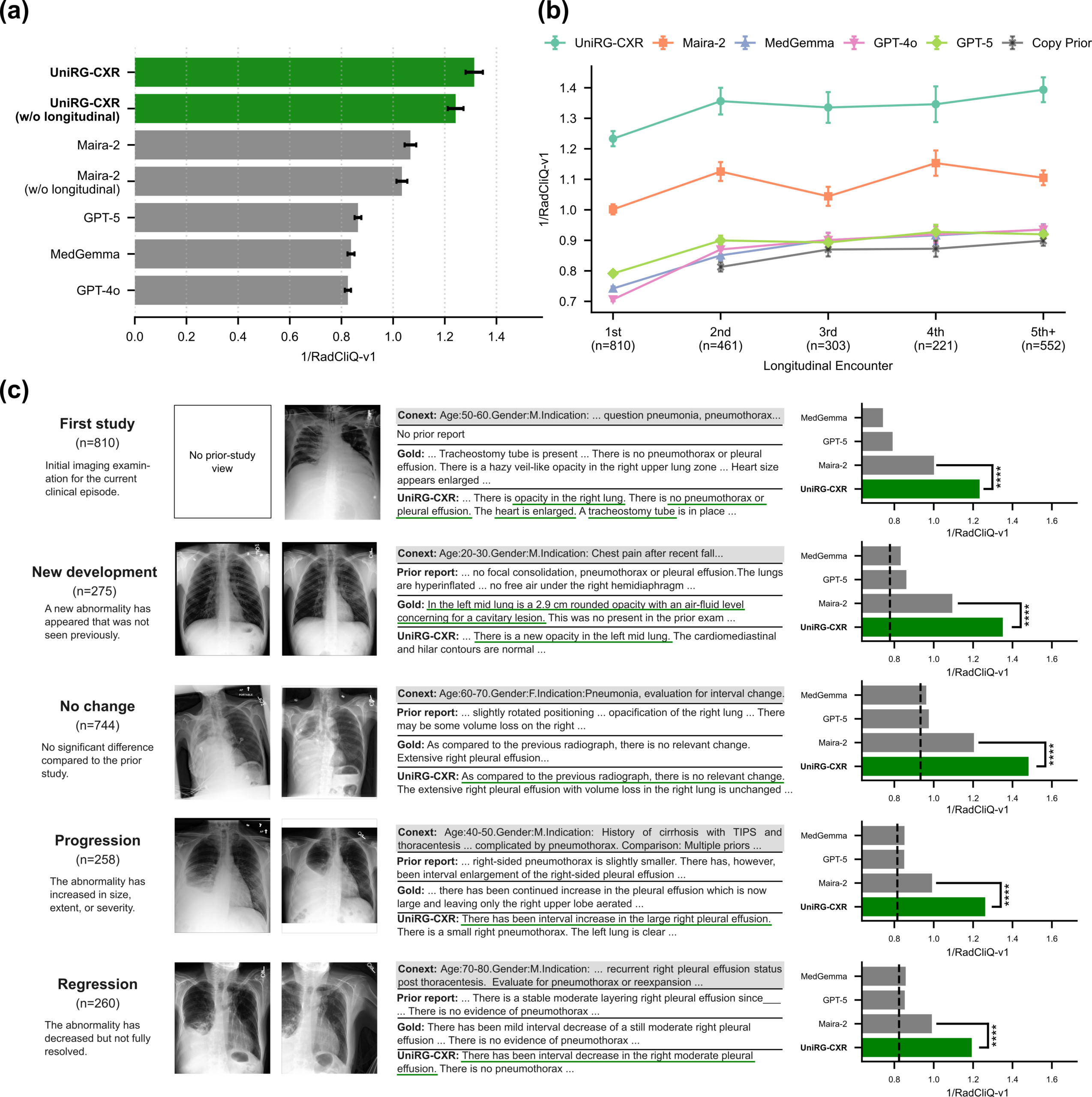
In clinical practice, radiologists often compare current images with prior exams to determine whether a condition is improving, worsening, or unchanged. UniRG-CXR is able to incorporate this historical information effectively, generating reports that reflect meaningful changes over time. This allows the model to describe new findings, progression, or resolution of disease more accurately, moving closer to how radiologists reason across patient histories rather than treating each exam in isolation (Figure 3).
Robust generalization across institutions and populations
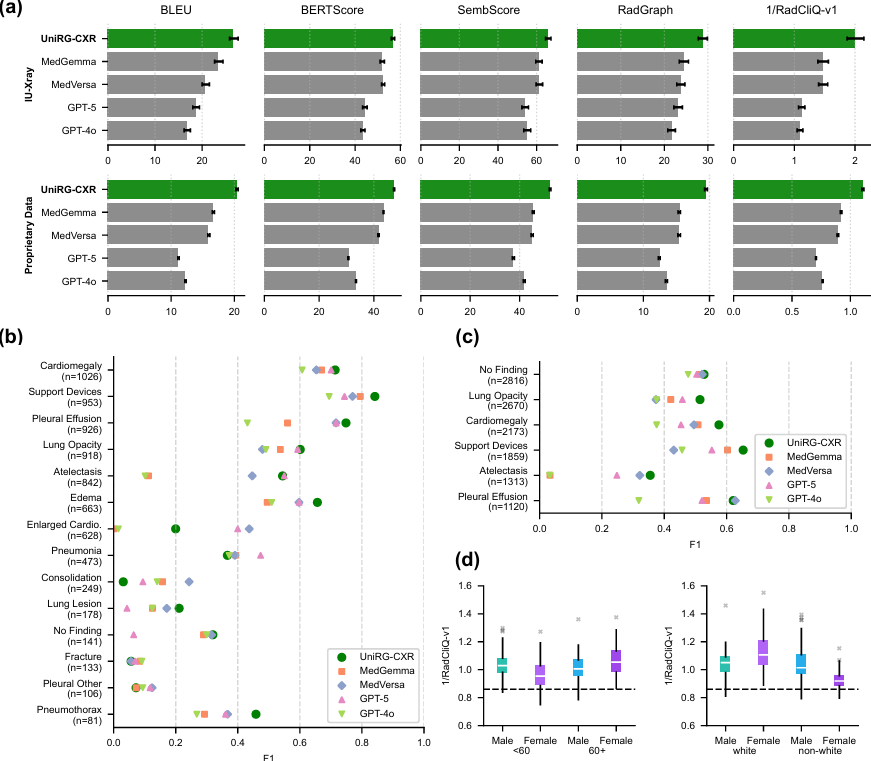
UniRG-CXR maintains strong performance even when applied to data from institutions it has never seen before. This suggests that the model is learning general clinical patterns rather than memorizing institution-specific reporting styles. In addition, its performance remains stable across different patient subgroups, including age, gender, and race. This robustness is critical for real-world deployment, where models must perform reliably across diverse populations and healthcare environments (Figure 4).
UniRG is a promising step toward scaling medical imaging report generation
UniRG introduces a reinforcement learning–based framework that rethinks how medical imaging report generation models are trained and evaluated. By directly optimizing clinically grounded reward signals, UniRG-CXR achieves state-of-the-art performance across datasets, metrics, diagnostic tasks, longitudinal settings, and demographic subgroups, addressing longstanding limitations of supervised-only approaches.
Looking ahead, this framework can be extended to additional imaging modalities and clinical tasks, and combined with richer multimodal patient data such as prior imaging, laboratory results, and clinical notes. More broadly, UniRG highlights the promise of reinforcement learning as a core component of next-generation medical foundation models that are robust, generalizable, and clinically aligned.
UniRG reflects Microsoft’s larger commitment to advancing multimodal generative AI for precision health (opens in new tab), with other exciting progress such as GigaPath, BiomedCLIP, LLaVA-Rad (opens in new tab), BiomedJourney, BiomedParse, TrialScope, Curiosity.
Paper co-authors: Qianchu Liu, Sheng Zhang, Guanghui Qin, Yu Gu, Ying Jin, Sam Preston, Yanbo Xu, Sid Kiblawi, Wen-wai Yim, Tim Ossowski, Tristan Naumann, Mu Wei, Hoifung Poon
Related publications
Scaling medical imaging report generation with multimodal reinforcement learning
Meet the authors

Sheng Zhang
Principal Researcher

Flora Liu
Senior Researcher

Guanghui Qin
Senior Researcher

Mu Wei
Principal Applied Science Manager
HLS

Hoifung Poon
General Manager, Real-World Evidence
Continue reading

GigaTIME: Scaling tumor microenvironment modeling using virtual population generated by multimodal AI

Navigating medical education in the era of generative AI

PadChest-GR: A bilingual grounded radiology reporting benchmark for chest X-rays
Advances in run-time strategies for next-generation foundation models
Research Areas


Research Groups
Related labs
Follow us:
Share this page: