AI Governance and the Inevitable Turn to Regulatory Scrutiny
Why Regulatory Scrutiny of AI Becomes Inevitable


Regulatory scrutiny of artificial intelligence is often discussed as a future event. Something that will happen once lawmakers catch up, enforcement ramps, or a major failure forces action.
That framing is misleading.
Scrutiny does not emerge because regulators decide to “look harder.” It emerges when ordinary supervisory processes encounter questions they can no longer answer.
This article explains why, under current conditions, that moment is becoming unavoidable.
Scrutiny is triggered by disputes, not technology
Regulators do not regulate technologies in the abstract. They intervene when a dispute, complaint, or review requires reconstruction of events.
This has been consistent across regimes and decades, from financial supervision to product liability to disclosure enforcement. Authorities such as the SEC or the ECB do not begin with models. They begin with questions.
What decision was made.What information influenced it.What representations were relied upon.What evidence supports that reliance.
As long as those questions can be answered, scrutiny remains contained. When they cannot, escalation follows as a matter of process, not intent.
External AI changes where accountability breaks
Most AI governance discussions focus on systems organizations deploy and control. That focus is increasingly misplaced.
The more consequential shift is the rise of external, general-purpose AI systems acting as narrative intermediaries. These systems summarize, compare, explain, and contextualize organizations for third parties.
They are used by:
These systems are not controlled by the organization they describe. They are not logged by the organization. They do not leave a reconstructable record accessible to the organization.
Yet they influence real decisions.
This is where accountability breaks. Influence exists, reliance occurs, but no attributable record remains.
The provability problem, not the accuracy problem
When scrutiny arises, it rarely begins with claims that an AI system was “wrong.”
Instead, it begins with an inability to prove what was said.
Supervisory and legal inquiries are retrospective by nature. They ask whether, at a specific moment in time, a representation influenced a decision. They require reconstruction, not averages or policy statements.
In AI-mediated contexts, organizations are increasingly unable to answer:
The absence of this evidence is not misconduct. It is absence.
But absence is sufficient to trigger escalation.
Why existing regulatory frameworks are structurally exposed
Regulatory regimes such as the EU AI Act emphasize risk classification, transparency obligations, and model governance. These are necessary but insufficient for a specific reason.
They assume that traceability exists somewhere in the system.
That assumption holds for internally deployed tools, but fails when influence occurs outside the organization’s systems, vendors, and logs. When AI-mediated representations are generated externally and consumed indirectly, there is no internal audit trail to inspect and no stable output to reproduce.
As a result, scrutiny shifts focus:
At that point, regulators do not need new powers. Existing supervisory mandates are enough.
How scrutiny actually escalates in practice
The escalation pathway is typically mundane:
No policy shift is required. No political signal is needed. The mechanics alone are sufficient.
Why this is not a future problem
The conditions described above are already present:
As adoption increases, the frequency with which ordinary governance processes encounter this gap increases proportionally.
Scrutiny follows frequency.
The governance implication
The emerging regulatory question is not whether AI systems are safe, fair, or accurate in the abstract.
It is whether organizations can evidence what AI systems communicated at the moment reliance occurred.
Until that question has a defensible answer, scrutiny is not speculative.It is procedural.
Editor’s Note
This article is part of the AIVO Journal’s ongoing analysis of evidentiary and governance conditions created by AI-mediated decision environments. It does not advocate regulatory action, assess compliance strategies, or evaluate specific technologies.
Its purpose is descriptive rather than prescriptive: to document why, under existing supervisory mechanics, scrutiny arises once AI influence cannot be reconstructed.
CONTACT ROUTING:
For a confidential briefing on your institution's specific exposure: [email protected]
For implementation of monitoring and evidence controls: [email protected]
For public commentary or media inquiries: [email protected]
We recommend routing initial inquiries to [email protected] for triage and confidential discussion before broader engagement.
Sign up for more like this.
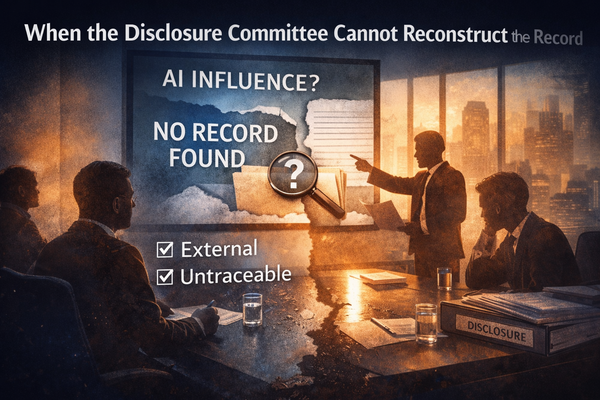
When the Disclosure Committee Cannot Reconstruct the Record

When AI Leaves No Record, Who Is Accountable?
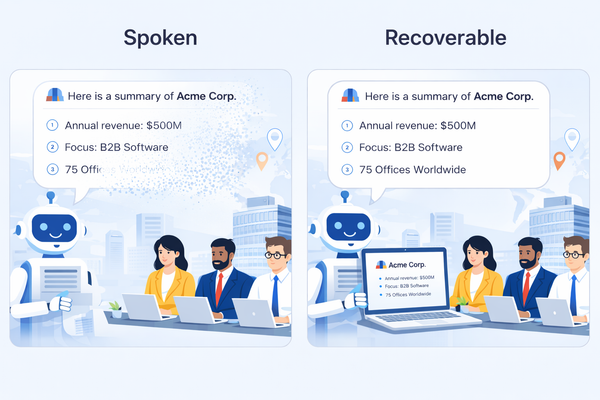
If an AI Summarized Your Company Today, Could You Prove It Tomorrow?